




 Go Pro


AI Science Solver
Solve science questions online with clear, step-by-step guidance from EaseDone. Work through physics, chemistry, biology, and other science topics with explanations that help you understand the method, not just see the final answer.
Solve Science Problems With Step-By-Step Help

A science AI solver helps you make sense of a difficult question by breaking it into smaller parts. Instead of receiving a bare answer, you can see which information matters, which formula or concept applies, and how the pieces fit together.
Use EaseDone when you are stuck on homework, checking a calculation, reviewing a class topic, or preparing for a science test. Ask a follow-up question whenever one step still feels unclear.
What Can You Solve With An AI Science Solver?
Science assignments can ask you to calculate, explain, compare, interpret, or apply a concept to a new situation. EaseDone gives you a place to work through those different question types across several common science subjects.
Physics Problems
Work through motion, forces, energy, electricity, waves, and other physics questions. EaseDone can help identify the known values, choose a suitable equation, substitute the numbers, and explain what the answer means in the problem.
Chemistry Questions
Review chemical reactions, balancing equations, the periodic table, atoms, bonding, molarity, and other chemistry topics. When a question involves several steps, ask for the reasoning behind each one so you can follow the process and check your work.
Biology Concepts
Get clearer explanations of cells, genetics, body systems, ecology, evolution, and other biology concepts. EaseDone can turn a dense question into plain-language points and show how the details relate to the larger idea.
Earth And Environmental Science
Study topics such as weather, climate, rocks, natural resources, ecosystems, and environmental change. Use the solver to compare processes, clarify unfamiliar terms, or organize an answer before you write it down.
Formulas And Calculations
Many science questions become manageable once the variables and units are clear. EaseDone can help you identify the right calculation, keep track of units, and review whether the final value makes sense in context.
How to Use EaseDone's AI Science Solver
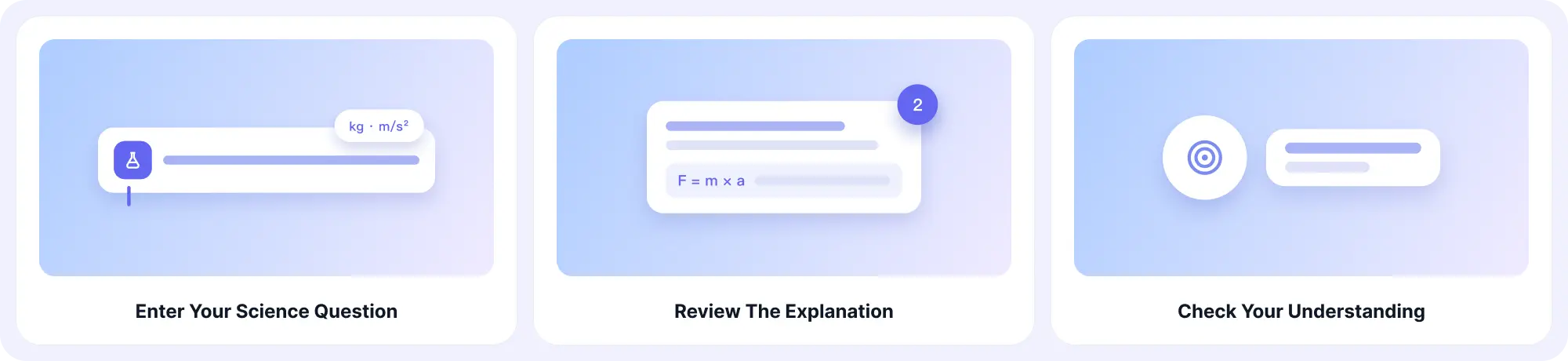
Start with the question you already have. You do not need to rewrite it into a perfect prompt before asking for help. A little context about the class, topic, or step where you are stuck can make the explanation more useful.
Step 1: Enter Your Science Question
Type the full question into the assistant and include the information provided by your teacher or textbook. You can mention the subject, the topic you are studying, and the part you do not understand. For a calculation, include the values and units so the solver can show the work in context.
Step 2: Review The Explanation
Read through the response from the first line to the last. Look for the given information, the concept or formula being used, the calculation, and the conclusion. If the wording is too advanced, ask for a simpler explanation or a worked example with different numbers.
Step 3: Check Your Understanding
Try the next step yourself before moving on to another question. You can ask EaseDone to create a similar practice problem, explain a mistake, or quiz you on the concept. This turns a one-time answer into a useful review session.
Use AI Science Solver For Different Study Tasks
The same science AI solver can be useful at different points in your schoolwork. You might need a quick explanation while doing homework, a second look at a mistake, or a focused review before an exam.
Complete Homework With A Better Understanding
When an assignment feels confusing, use the solver to separate the instructions from the actual problem. Work through the key idea first, then use the explanation to write your own response or complete the calculation.
Review Before A Science Test
Ask for a recap of a topic, a list of important terms, or practice questions that resemble the material you have been learning. This helps you find weak spots before test day instead of rereading every page in the same way.
Understand A Mistake
Paste in the step that gave you a different answer from the textbook or answer key. EaseDone can help compare the approaches and point out where a unit, sign, definition, or assumption may have changed the result.
Practice Similar Questions
Once you understand one problem, ask for another with the same type of reasoning. Changing the numbers or setting makes it easier to tell whether you know the method or only remember the original answer.
Review Textbook And Class Questions
Use the assistant to unpack unfamiliar wording, connect a question to the relevant lesson, and turn a long explanation into a shorter review outline. It can be a useful starting point when you are not sure what to study first.
Work With Data And Measurements
Science often involves tables, rates, averages, probability, and measurements. For questions that need more focused data support, continue with the AI statistics solver to review statistical reasoning in a dedicated workspace.
Explore Economics-Related Questions
If a class combines science with markets, policy, or resource decisions, the AI economics solver can provide more focused help with economics-related questions.
Why Use EaseDone For Science Questions?

See The Reasoning Behind the Answer
A final number is not much help if you do not know how to reach it. EaseDone lays out the thinking behind a response so you can use the same approach on related questions.
Move Between Subjects In One Place
Your study session may cover biology one day and physics or chemistry the next. EaseDone keeps the interaction familiar while the subject and type of question change.
Ask For The Level Of Detail You Need
You can request a short definition, a deeper explanation, a simple analogy, or a complete worked solution. That makes it easier to adjust the response when the first version does not match your level.
Turn Help Into More Practice
After solving a question, keep going with our AI quiz generator. Ask for a similar problem, a quick concept check, or a review of common mistakes so the session supports learning beyond a single assignment.
AI Science Solver FAQs
What Is An AI Science Solver?
An AI science solver is an online tool that helps explain and work through science questions. It can support topics such as physics, chemistry, biology, Earth science, formulas, and calculations by showing the reasoning behind a response.
Can I Use EaseDone To Solve Science Questions Online?
Yes. Enter your question in EaseDone and use the response to review the relevant concept, formula, calculation, or explanation. You can also ask follow-up questions when you need a different example or a simpler breakdown.
Does The AI Science Solver Give Step-By-Step Answers?
EaseDone is designed to explain the steps involved in a solution, including the information given, the method being used, and the conclusion. Always read through the reasoning and check important answers against your class materials.
Can An AI Science Solver Help With Physics And Chemistry?
Yes. You can use it for common physics and chemistry topics, including forces, motion, energy, equations, atoms, reactions, bonding, and calculations. The quality of the explanation depends on the question and the context you provide.
Can It Help With Biology Homework?
Yes. EaseDone can explain biology concepts such as cells, genetics, body systems, ecology, and evolution. Ask it to define a term, compare two processes, organize a response, or explain how several details connect.
Can I Ask The Solver To Explain A Mistake?
Yes. Share your working and the answer you expected, then ask where the approach may have changed. Reviewing a mistake can be more useful than seeing a replacement answer because it shows what to watch for next time.
Is EaseDone's AI Science Solver A Replacement For A Teacher?
No. It is a study aid for explanations, practice, and review. It should support your classwork rather than replace your teacher, textbook, lab instructions, or school guidance. For important academic work, verify the information and follow your course rules.